
Product variants can be automatically derived from customer requests to production release.
We automate the variant creation process for mechanical and mechatronic systems, covering everything from sales and engineering to industrial engineering.
Challenge
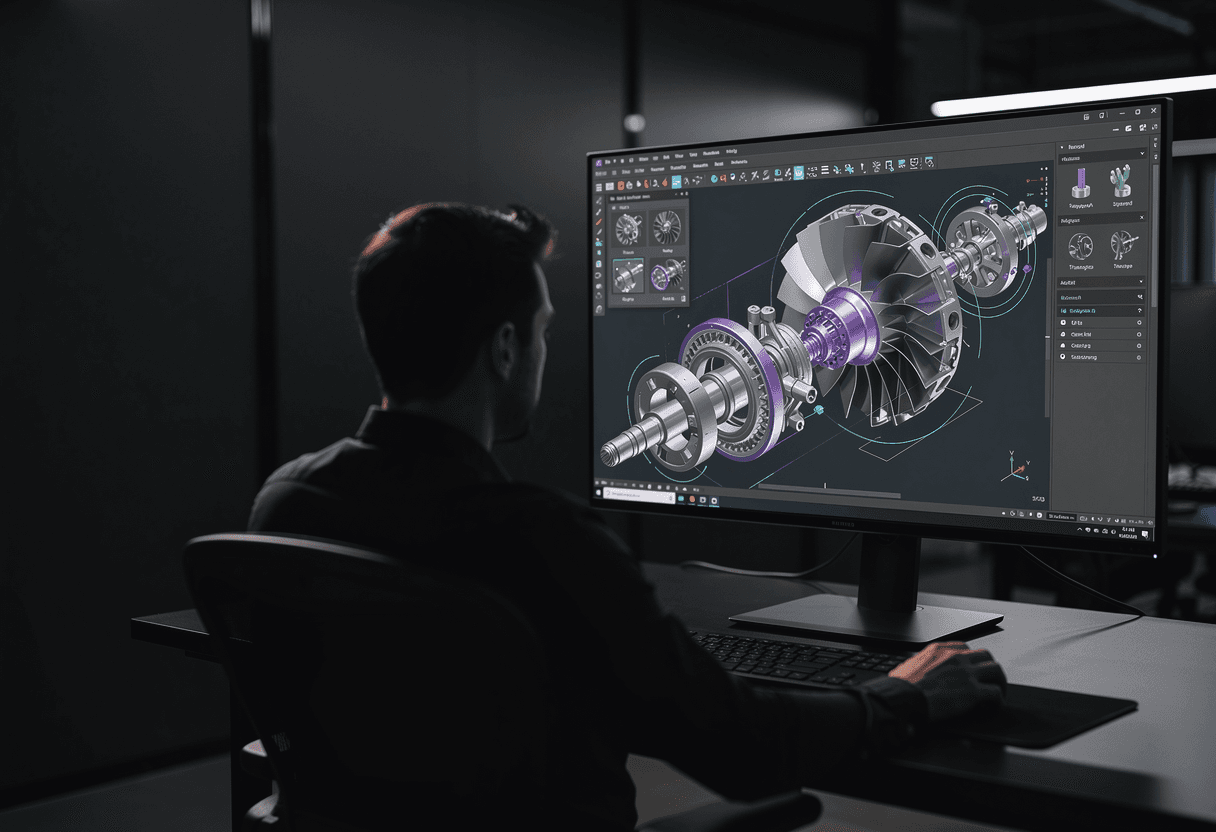
Variant creation is quite manual. Engineers lose time through repetitive tasks and redevelop many things that have actually already been developed. The result: long lead times and high costs.
What’s different today?
New technologies make a new approach possible.
Knowledge
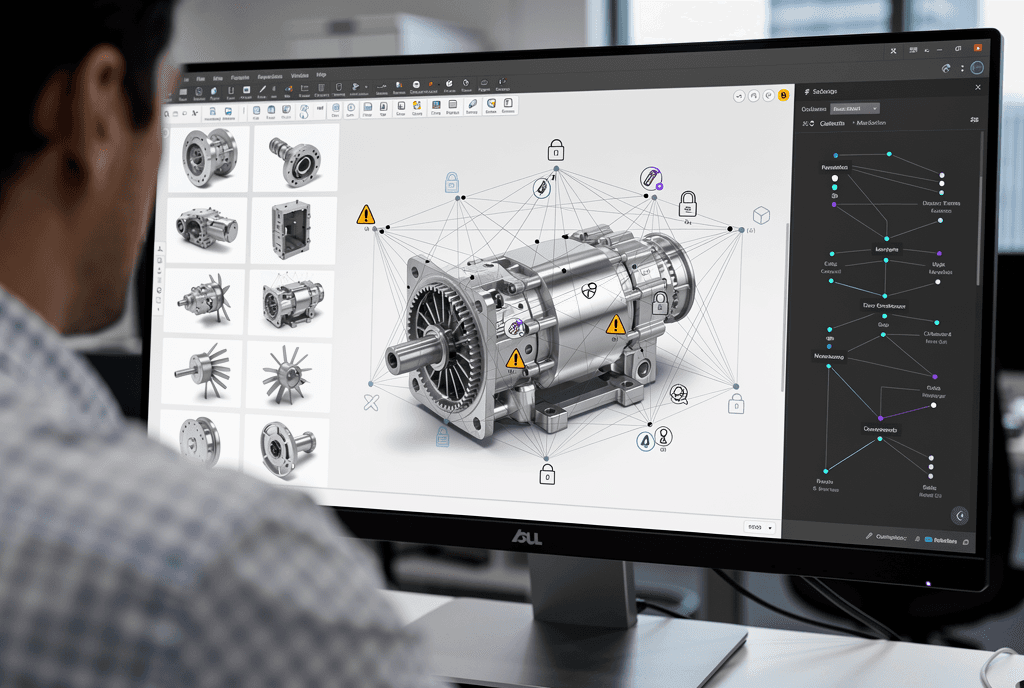
Modern AI can capture and connect product knowledge across requirements, product data, and process steps. This creates a structured, machine-readable foundation for automation.
Systems
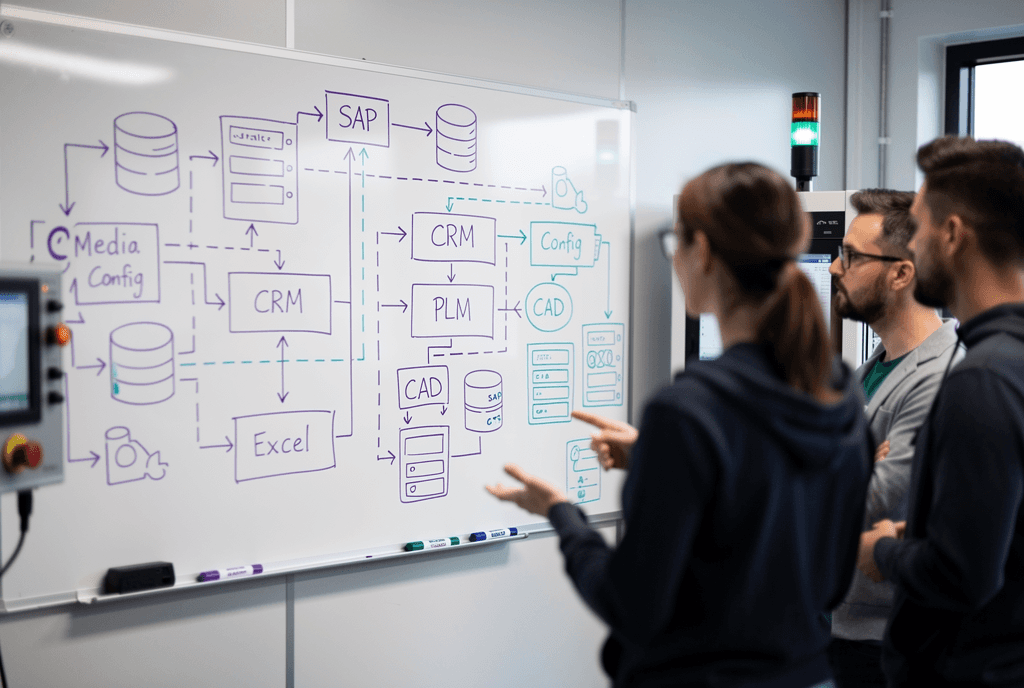
Instead of building one-off interfaces, you can connect existing systems through standard connectors and adapters. That reduces integration effort and keeps your tool landscape flexible.
Automation
Information can be analyzed, shared, and executed automatically.
Automate step by step—without a risky big-bang rollout.
By combining workflows, knowledge graphs, and AI, we enable scalable, sustainable automation of variant engineering.
Interfaces
A library of standard connectors for major engineering and planning tools makes it easy to integrate fragmented IT landscapes. This reduces the need for costly custom development and avoids lock-in to a closed, single-vendor platform.
Workflow automation
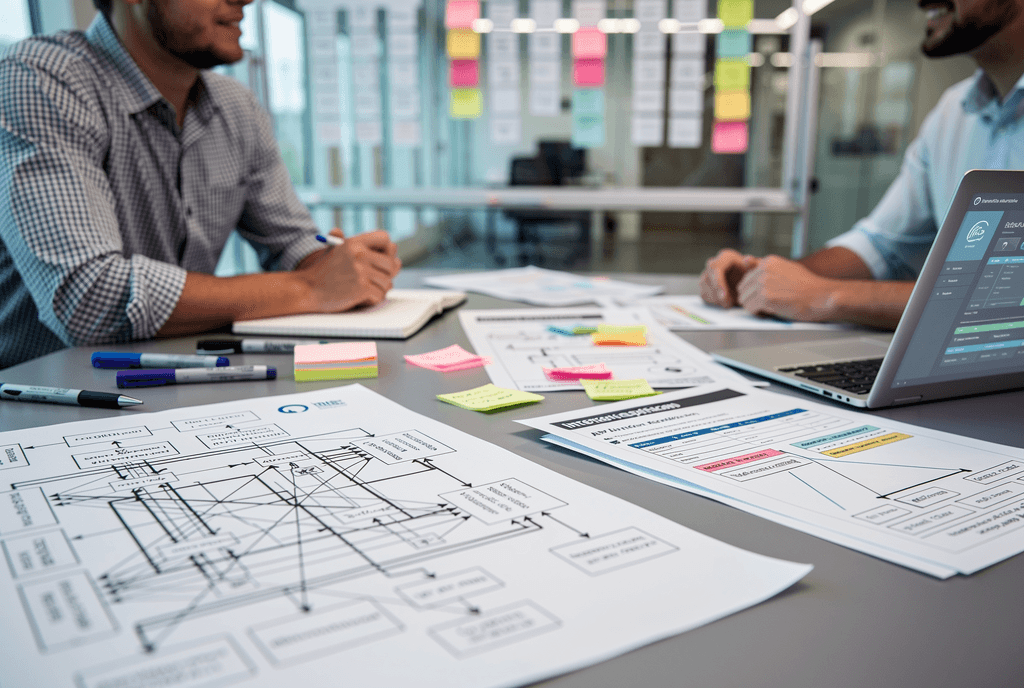
Workflows define what information is needed, how it is transformed, and where decisions stay with people. You can automate step by step—without coding. For complex tasks, AI agents can support or execute individual steps.
Knowledge graph
For AI to work reliably, you need a shared, machine-readable knowledge layer. We capture and link relationships between requirements, products, and processes across your systems—creating a knowledge graph that is understandable for people and usable by AI.
AI services
On top of this foundation, AI services can identify similar products and assemblies, recommend suitable manufacturing resources for a component, and generate assembly precedence graphs from historical work plans.
Industries
For companies building highly variant mechanical and mechatronic products.





Personnel costs
Revenue
Lead time
A platform for engineers
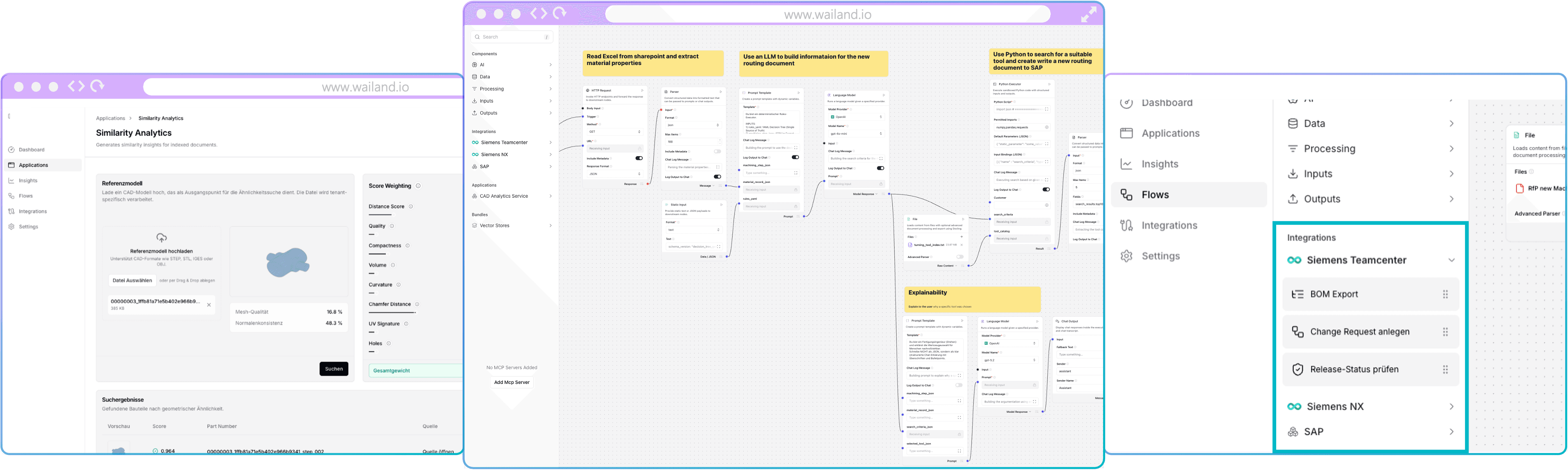
Model tasks and workflows in an easy-to-use editor—and automate them step by step. Use standard connectors for PLM, CAD, ERP, and Excel, and add capabilities like CAD similarity search, LLMs, or deterministic rule sets via drag and drop. Start small and scale automation across variant engineering—without a risky big-bang rollout.
Where can you get the biggest gains in variant engineering?